

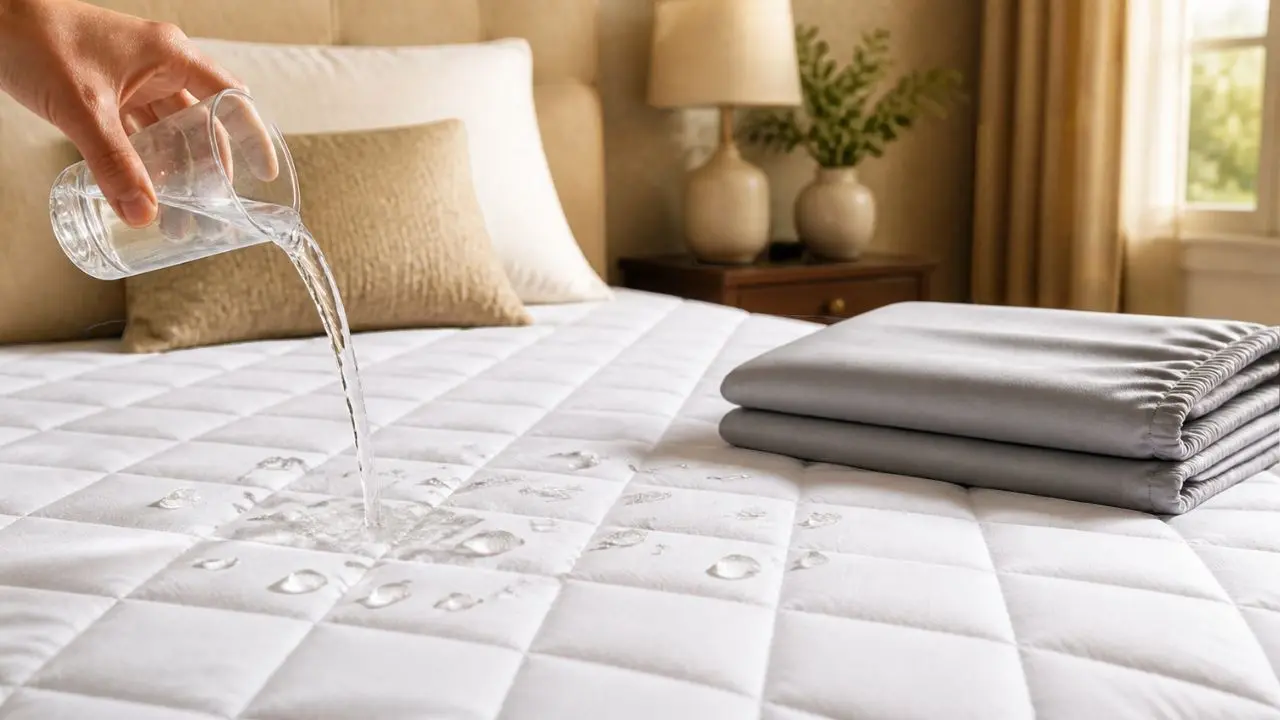
Which Fabric Is 100% Waterproof and Which Ones Only Pretend
It’s 3 am. Your child has wet the bed, and the “waterproof” cover you bought last month is soaked right through to the mattress. Or the monsoon hits, and the washing machine cover on the roof turns into a wet rag by morning.
Both covers were sold as waterproof. Neither one was. Most people, and many sellers, call any fabric “waterproof” if it holds off a few drops for a few seconds. A truly waterproof fabric does far more than that, and the difference comes down to one thing: a barrier.
Quick answer: No woven fabric is 100% waterproof on its own. Cotton, polyester, nylon and microfiber all have tiny gaps between their threads. A fabric becomes 100% waterproof only when it carries a solid barrier layer, such as TPU, PU, PVC (vinyl), rubber or a PTFE membrane. For home use in Pakistan, TPU laminated fabric is the best all-round choice. It blocks liquid completely, and its breathable grades stay soft, quiet and cool on the skin.
Need a cover that actually stops liquid? Our waterproof mattress covers use a TPU coated breathable membrane, with no heat and no crinkle noise. Open the parcel and check the quality before you pay, with free delivery across Pakistan. Questions? WhatsApp +92 303 7474074.
Waterproof, Water Resistant and Water Repellent Are Not the Same
These 3 terms appear on labels as if they mean one thing. They don’t.
| Term | What It Means | What Happens to Water | Good For |
|---|---|---|---|
| Waterproof | A solid barrier blocks liquid completely, even under pressure and over time | Water stays on top, even if it sits for hours | Bedwetting, elderly care, outdoor appliance covers, monsoon |
| Water resistant | A tight weave slows water down | Water soaks through after some time or pressure | Light splashes, short drizzle |
| Water repellent | A chemical finish makes water bead and roll off | Water rolls off at first, then soaks in once the finish wears down | Light rain, quick spills |
A water repellent finish fades with washing and rubbing. A water resistant fabric fails under pressure, such as a child sitting on a wet spot. Only a waterproof barrier holds every time.
How Waterproofness Is Measured
Fabric labs use a test called hydrostatic head. They clamp the fabric over a chamber and raise the water pressure underneath until drops appear on the other side. The result is given in millimetres of water. A rating of 1,000 mm means the fabric held back a water column 1 metre high.
The international test method is ISO 811, last reviewed and confirmed in 2025. In the US, labs use the similar AATCC 127 method. ISO 811 only measures. It does not set a pass mark, so different markets and standards draw the “waterproof” line in different places.
| Hydrostatic Head | What It Usually Means |
|---|---|
| Below 1,000 mm | Water resistant, not waterproof |
| 1,000 to 1,500 mm | The point most outdoor brands start calling a fabric waterproof |
| 1,500 mm | A commonly cited minimum for a “waterproof” label in the UK market |
| 5,000 mm | A common minimum for tent floors, which take body weight on wet ground |
| 10,000 mm | A common benchmark for quality rain jackets |
| 20,000 mm and above | Heavy rain, heavy backpacks, long exposure |
The European Standard for Rainwear
Europe’s EN 343:2019 standard for protective rain clothing goes a step further. It tests the fabric after “pretreatment,” which means washing, rubbing and flexing, to check that the barrier survives real use. It measures pressure in Pascals (Pa). We have converted each class into millimetres so you can compare.
| EN 343 Class | Minimum Water Pressure | Approximate Hydrostatic Head |
|---|---|---|
| Class 1 | 8,000 Pa, tested before pretreatment | About 816 mm |
| Class 2 | 8,000 Pa, tested after pretreatment | About 816 mm |
| Class 3 | 13,000 Pa, tested after pretreatment | About 1,326 mm |
| Class 4 | 20,000 Pa, tested after pretreatment | About 2,039 mm |
The key lesson for any buyer: a fabric that passes when new but fails after washing was never truly waterproof for daily use.
Why Pressure Matters at Home
Rain falling on a cover puts very little pressure on it. Body weight is a different story. Outdoor gear makers estimate that sitting on a wet surface creates pressure of around 2,000 mm. Estimates for kneeling vary widely, from about 4,800 mm up to 14,000 mm, depending on body weight and the size of the contact area.
A mattress takes this kind of pressure every night. A child sitting up in a wet patch pushes urine into the fabric far harder than any rain. That is why a mattress cover needs a true barrier, not just a tight weave or a spray finish.
How a Fabric Becomes Waterproof
Manufacturers use 3 main methods to turn an ordinary fabric into a waterproof one.
- Coating: A liquid layer of PU, PVC, silicone or acrylic is spread onto the fabric and cured. Coating is affordable and common on parachute fabric, tarpaulins and appliance covers.
- Lamination: A ready-made film, such as TPU or PU, is bonded to the fabric with heat or adhesive. Lamination gives a more even barrier, so it is the standard method for quality mattress protectors.
- Membrane construction: A thin breathable membrane, such as PTFE or PU, is sandwiched between an outer fabric and an inner lining. This is how high-end rain jackets are built.
How Waterproof Fabric Breathes
A waterproof barrier stops liquid water. A breathable one also lets sweat vapour escape, so you don’t feel clammy. Breathable barriers work in 2 ways:
- Microporous membranes: PTFE membranes have pores small enough to block liquid droplets but large enough to let vapour molecules pass through.
- Monolithic (solid) films: Breathable TPU and PU films have no holes at all. Vapour moves through the film itself at the molecular level, while liquid stays out.
Labs measure breathability as MVTR (grams of vapour per square metre over 24 hours, higher is better) or RET (lower is better). For a hot Pakistani bedroom between May and September, breathability matters almost as much as waterproofing.
5 Materials That Make a Fabric 100% Waterproof
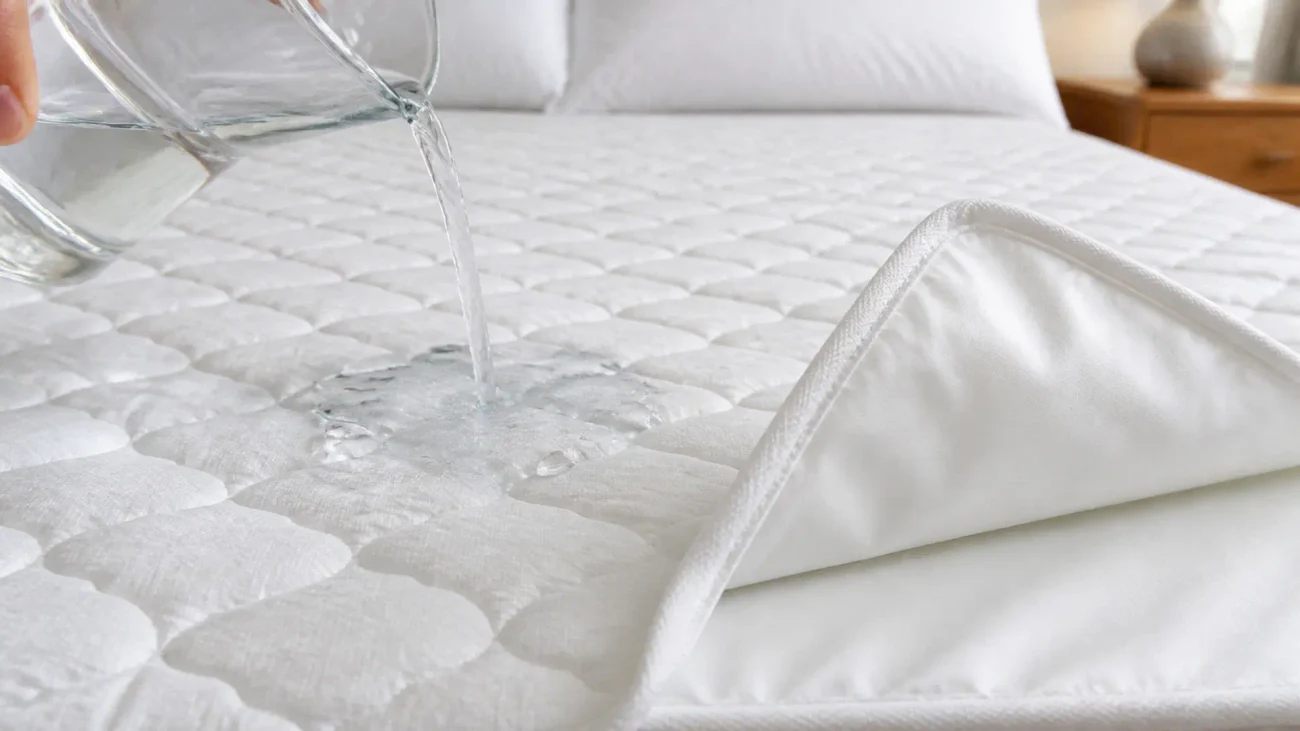
Each of these forms a continuous layer with no gaps for liquid water to pass through.
| Barrier Material | Feel and Noise | Breathability | Heat Tolerance | Best Home Use |
|---|---|---|---|---|
| TPU (thermoplastic polyurethane) | Soft, matte, almost silent | Good in breathable grades | Good | Mattress protectors, baby and elderly bedding |
| PU coating or PUL (polyurethane laminate) | Soft, quiet when well made | Moderate | Fair, weakens with very hot washes | Mattress pads, changing mats, sofa covers |
| PVC (vinyl) | Shiny, stiff, crinkles loudly | Very poor, feels sweaty | Poor, flexible PVC has a continuous use limit of about 50 to 60°C | Hospital mattress sheets, tablecloths, tarpaulins |
| Rubber, latex and neoprene | Heavy, grippy | Very poor | Fair | Gloves, mats, wetsuits |
| PTFE membrane (such as Gore-Tex) | Light, flexible | Excellent | Excellent | Rain jackets, tents, outdoor gear |
For a hot Pakistani bedroom, PVC is the worst choice. It traps sweat, crinkles every time you turn over, and long exposure to strong summer heat makes it stiffen and lose shape. TPU solves all 3 problems, which is why we use a TPU coated membrane in our mattress protectors.
On a TPU backed protector, water stays on top instead of soaking into the mattress.
Fabrics That Are Only Water Resistant
These fabrics are often sold as waterproof, but on their own they are not. The table shows each fibre’s commercial moisture regain, the standard figure for how much moisture a fibre holds in normal air. A low number means the fibre itself absorbs little water, but water can still pass through the gaps in the weave.
| Fabric | Moisture Regain | How It Handles Water | Becomes Waterproof When |
|---|---|---|---|
| Polyester | About 0.4% | Fibre barely absorbs water, but water passes through the weave | Coated or laminated with PU or TPU |
| Nylon (including parachute) | About 4 to 4.5% | Tight weave beads water at first, then seeps under pressure | Coated with PU or silicone |
| Microfiber | About 0.4% (polyester based) | Very fine threads slow liquid briefly | Laminated with a barrier film |
| Cotton | About 8.5% | Absorbs water and soaks through quickly | Laminated, or used as a top layer over TPU |
| ELS cotton (Ventile type) | About 8.5% | Long fibres swell when wet and tighten the weave | Not by itself, as it stays below 1,000 mm |
| Wool | About 13.6 to 16% | Lanolin sheds light rain, but wool can absorb about 30% of its weight in water | Not practical for home covers |
Ventile, the best-known water resistant cotton, makes a useful example. Its makers list a hydrostatic head of 400 to 850 mm for the Original range. That is impressive for a cotton fabric, yet it still falls short of the 1,000 mm level most sources treat as truly waterproof.
Waxed cotton and oilcloth work in a similar way. Wax or oil helps the surface shed water, but the coating wears off and needs reapplying.
Why Seams Matter as Much as Fabric
A cover is only as waterproof as its weakest point. Every needle hole in a seam is a tiny opening. A 100% waterproof fabric stitched carelessly still leaks along the stitch line.
Manufacturers handle seams in 4 ways:
| Seam Type | How It Works | Waterproof? |
|---|---|---|
| Plain sewn seam | Needle and thread join the layers | No, water leaks through needle holes |
| Taped seam | A waterproof tape is heat-sealed over the stitches | Yes, if the tape stays bonded |
| Welded seam | Heat, radio frequency or ultrasonic energy melts the layers together | Yes, no needle holes at all |
| Ultrasonic quilting | Sound vibrations fuse synthetic layers into a quilted pattern without thread | No needle holes in the quilting itself |
Ultrasonic quilting deserves a special mention. It uses high-frequency vibrations to fuse layers, so there are no needle holes for water to creep through. It works only on synthetic fabrics or blends with a high synthetic content, which is why ultrasonic covers are usually polyester based. Our waterproof sofa cover range uses ultrasonic construction.
On a quilted mattress protector, check where the waterproof layer sits. If the barrier is under the quilting rather than stitched through it, the stitches don’t pierce it.
The Right Waterproof Fabric for Every Cover in Your Home
| Item | Main Threat | Best Waterproof Fabric | Our Option |
|---|---|---|---|
| Child’s or elderly person’s mattress | Urine, sweat, night accidents | TPU membrane under terry or quilted cotton | Quilted fitted protector from Rs 2,299 |
| Full mattress protection | Liquid, dust and spills on every side | TPU zipper cover | Zipper mattress cover, 2 side and 6 side |
| Sofa in a TV lounge | Chai, juice, pets | Ultrasonic or quilted fabric with waterproof backing | Waterproof sofa cover range |
| Washing machine on a roof or courtyard | Monsoon rain, sun, dust | Coated parachute fabric | Twin tub cover from Rs 1,499 |
| AC indoor and outdoor unit | Dust, rain in the off season | Quilted or coated parachute fabric | AC covers for 1, 1.5 and 2 ton |
| Fridge and microwave | Kitchen spills, dust, grease | Quilted waterproof fabric | Fridge and oven covers from Rs 799 |
Never cover an outdoor AC unit while it is running. The unit needs open airflow. Use the cover only in the off season.
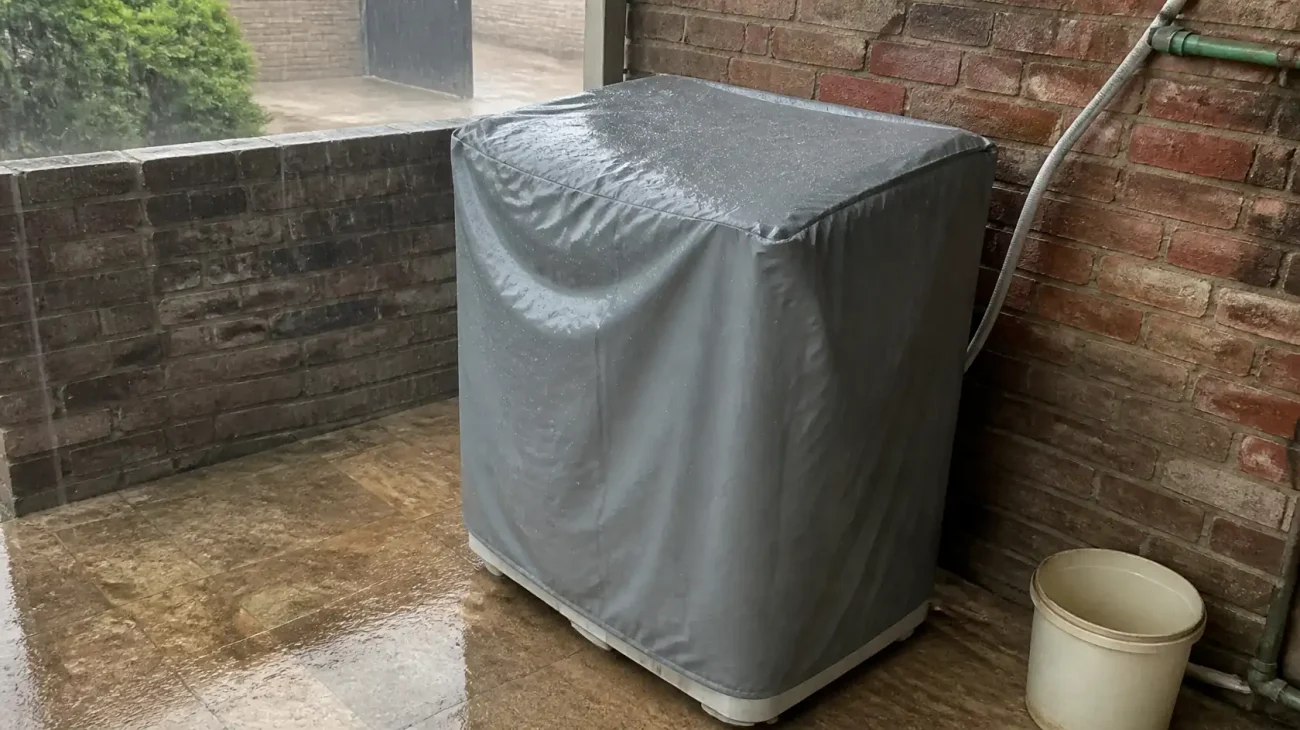
A waterproof parachute cover keeps a rooftop washing machine dry through monsoon rain.
Mattress Protector Types Compared
| Type | Coverage | Best For |
|---|---|---|
| Quilted fitted protector | Top surface, held by elastic sides | Everyday spill and sweat protection with extra softness |
| Terry fitted protector | Top surface with an absorbent cotton terry face | Bedwetting, as terry soaks up the first splash |
| 6 side zipper cover | Every surface of the mattress, fully zipped | Maximum protection from liquid and dust |
A note on bed bugs: a zipper cover is not automatically bed bug proof. The US EPA advises choosing a high quality encasement that resists tearing and checking it regularly for holes. Treat any infestation with proper pest control, not with a cover alone.
A 30 Minute Test to Check Any Waterproof Cover at Home
You don’t need a lab to check a cover. Try these 4 simple tests the day it arrives:
- The water test: Lay the cover flat over a dry tissue. Pour half a glass of water on top and press down lightly with your palm. After 30 minutes, check the tissue. Any damp spot means the barrier fails.
- The pressure test: Press your fist firmly into the wet spot for 1 minute. This copies the pressure of someone sitting on it.
- The noise test: Scrunch the cover in your hands. A loud plastic crinkle usually means PVC. TPU feels soft and stays almost silent.
- The backing check: Turn the cover over. A shiny, stiff backing usually means vinyl. A smooth, matte, flexible backing points to TPU.
Every Buruj order comes with an open parcel policy, so you can inspect the fabric at your doorstep before paying. If you find a manufacturing defect within 10 days, our refund policy gives you your cash back.
4 Common Myths About Waterproof Fabric
- “Thicker means more waterproof.” Thickness adds comfort, not protection. A thin TPU film blocks liquid better than a thick quilted fabric with no barrier.
- “Waterproof covers are always hot and sweaty.” That is true of PVC. Breathable TPU lets vapour escape while blocking liquid.
- “If water beads, the fabric is waterproof.” Beading comes from a repellent finish. Water can still soak through under pressure once the finish wears down.
- “A plastic smell means it’s waterproof.” A strong smell usually points to cheap PVC, not better protection.
A Note on Chemical Water Repellent Finishes
Many outdoor jackets and sprays use a durable water repellent (DWR) finish based on PFAS chemicals. These are called “forever chemicals” because they stay in the environment for a very long time.
The European Union has restricted one PFAS group, PFHxA, under EU Regulation 2024/2462. The ban applies to clothing textiles sold to the public from 10 October 2026 and extends to other consumer textiles from 10 October 2027.
For home covers, this is one more reason to choose a solid TPU barrier. It blocks water through its structure, not through a surface spray that washes away.
How to Care for a Waterproof Cover
A waterproof layer lasts for years with the right care:
- Wash in cold water: Hot water weakens PU and TPU layers over time.
- Skip the bleach: Bleach attacks both the coating and the fabric dye.
- Never iron the waterproof side: Direct heat can melt or crack the membrane.
- Dry in the shade: Strong direct sun ages coatings faster.
- Wash new covers before first use: This removes any loose dye and softens the surface.
Replace a cover when you see peeling or flaking on the backing, the film turns stiff, or the water test shows a damp spot. For accidents on the mattress itself, our guide on removing urine smell explains what works and what makes it worse.
Frequently Asked Questions
Is polyester 100% waterproof? No, plain polyester is only water resistant. The fibre absorbs very little water, but water seeps through the gaps in the weave under pressure. Polyester becomes fully waterproof once it is coated or laminated with PU or TPU.
Is TPU better than PVC for a mattress protector? Yes, for most homes in Pakistan. TPU blocks liquid just as well, and its breathable grades stay soft, quiet and cool. PVC traps sweat, crinkles loudly and stiffens with long exposure to strong heat.
Is parachute fabric waterproof? Plain parachute fabric is water resistant because of its tight weave. It becomes truly waterproof once a PU or silicone coating is applied. Always check that a parachute cover is coated, not just tightly woven.
What hydrostatic head rating counts as waterproof? ISO 811 measures the rating but sets no pass mark. Most brands treat 1,000 to 1,500 mm as the starting point for waterproof. Products under body weight, such as tent floors, need 5,000 mm or more.
Does a waterproof cover lose its waterproofing over time? A TPU or PU barrier lasts for years with cold washing and no bleach. A water repellent spray or finish wears off much faster. Hot washes, ironing and harsh detergents shorten the life of any waterproof layer.
What is the best waterproof fabric for bedwetting? A TPU membrane under a soft terry or quilted cotton top works best. The cotton absorbs the first splash, and the TPU stops liquid from reaching the mattress. A 6 side zipper cover adds protection on every side.
Choose a Barrier, Not a Promise
A 100% waterproof fabric always has a solid barrier, sealed seams, and a finish that survives washing. For home use, breathable TPU gives you that barrier without the heat and noise of plastic. Check the label, test the cover at home, and pick the right fabric for each job.
Shop our waterproof mattress covers and appliance covers, made in Faisalabad textile mill, with free delivery and Cash on Delivery across Pakistan. Not sure which one you need? Send us a message on WhatsApp at +92 303 7474074.